
Doing Our Job
If You Don't Ask Questions You Aren't A Journalist

Balkan media generally aren’t too big about asking questions. Sometimes this reaches painful dimensions – as I’ll show in a case where at least two people did their job as journalists.
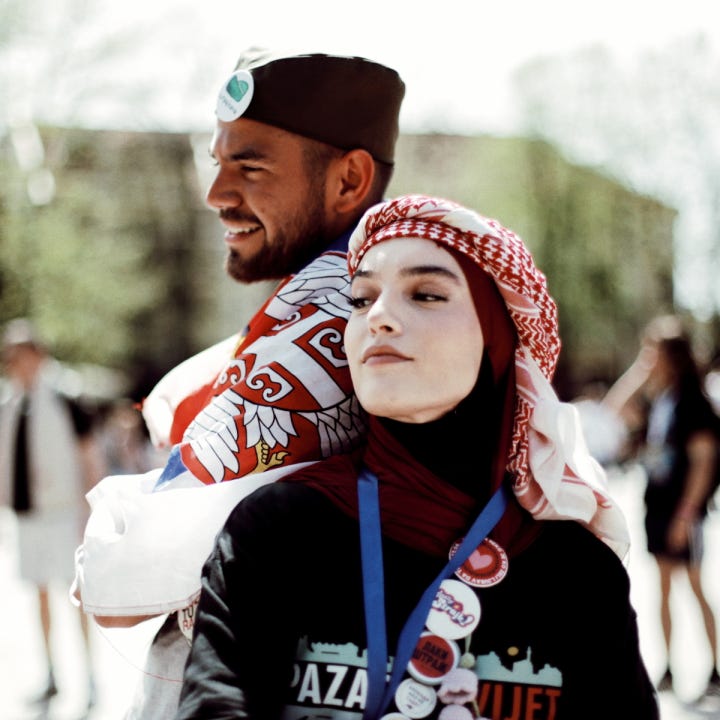
Few photos from the students‘ protests in Serbia have become as iconic as the one of Nadija and Sava. One might even say they have become the Face of New Serbia – at least in some respects.
Why is intuitively obvious to anyone who knows anything about the Balkans in general and Serbia in particular. I have outlined this in this piece I published this week.
Nadija’s and Sava’s photo has been reproduced in probably hundreds of newspapers, on countless news portals, has been shared hundreds of thousands of times on social media, as well as been used by probably every group of students active in the current mass protests in Serbia.
This makes it all the more astonishing that until this week, apparently no journalist asked who Nadija and Sava were, what they thought, or how this photo was made.
Rather, when a touching video went viral that showed their reunion on a student foot march to Novi Sad, bringing them back to public memory, basically every news outlet copied a press statement by student activists word by word, and that was that.
That statement apparently contained little info beyond that they had met on the march to the protests in Novi Sad, that it was very emotional, and how their respective attire highlighted how two very different Serbias were now united and overcoming predjudices.
This included well respected and respectable outlets such as Radio Sarajevo or Nova.
Only one regional outlet was interested in who Nadija and Sava actually were, and got into touch with them.
That was Freemedia.rs from Novi Pazar. A small, mainly local website, with a handful of people. This is not to put down Freemedia, I’m just juxtaposing this with those big outlets with lots of people on their payroll who had done no such thing.
Editor in chief, Amela Bajrović, asked both of them how they felt about the prospect of the ongoing mass protests, what motivated them to be active in the protest movement, and how they felt it had changed the country.
It was the first time anyone ever gave them a voice. Read the piece here.
I don’t want to go too much into detail here as I really hope you’ll read the entire story on Freemedia.
The Story Behind The Photo
Likewise, from all I could gather, no one had ever thought to ask how the iconic photo came to be that made Nadija and Sava the Face of New Serbia. This is in spite of the fact photographer Irfan Ličina had taken the photo in April already during a protest in Kraljevo, and published it the same day.
When a photo becomes as iconic as this one, it’s baffling to see that no journalist is interested in how it was taken, and why. Besides, it isn’t exactly respectful towards the work of a colleague like a news photographer such as Irfan.
I was the first one to get in touch with Irfan, and to present the story behind one of the symbols of Serbia’s student protests.
Now, my blog Balkan Stories infamously is a one man show, and I’m running this blog in the time my dayjob as a journalist leaves me. Without going into details, but reporting on the Balkans isn’t what I’m paid for, and this blog makes around 30 Euros in donations per month – just enough to cover immediate costs such as for WordPress packages and domain hosting.
That’s not to rant, but again to juxtapose it with tons of Balkan media whose employees one might think would get paid to do exactly what I did for free, and what Amela did for a lot less money than major news outlets make.
The Dead Woman on The Beach
Irfan’s photo of Nadija and Sava isn’t the only example showing how Balkan media often neglect doing their job.
When a woman died on a public beach in Ulcinj in Montenegro, local media didn’t pick up the story. I had written about what I had witnessed – I was there as paramedics were trying to resuscitate her and how she was pronounced dead -, and that was all I ever found about an event that would ordinarily be the talk of town.
Like it or not, but when a woman dies on a beach during the tourism season, in front of dozens of witnesses, this is news. Particularly when police investigate.
For various reasons, I couldn’t follow up on the story.
There is reporters in Ulcinj itself that are paid to do that. They didn’t.
A Scandal No One Cares About
Likewise, it’s baffling how almost ostentaciously un-curios Balkan journalists are on subjects such as the rambling gambling addiction in the region. To the best of my knowledge, I was the first one to at least attempt to show the dimensions of the gambling and betting industry in former Yugoslavia.
When I informed a local journalists about my findings, namely that gambling and betting made up up to five per cent (!) of Bosnia’s economy – all on the backs of addicts, their families and friends – he just shrugged. „We know it’s a big thing, so why care?“
The dimensions – again: gambling and betting are five per cent of a country’s economy, and every adult Bosnian spends roughly one monthly salary in a casino or a betting cafe each year on average – are so mind boggling that it defies my imagination how anyone could not think that this is a major issue, and that it needs spelling out.
The Question No One Asked
Likewise, a violent attack on student activists in Novi Sad earlier this year officially caused the then government to resign.
There was one very obvious question no major news outlet in the country ever asked: What are several armed thugs doing in the office of a political party in literally the middle of the night?
Why Care About Demographics?
Returning to Bosnia: It’s always surprising to how few media outlets it ever occurs to ask how many people actually live in the country, and why there is 32,7 per cent gap between the two relevant numbers the Statistical Office of Bosnia and Hercegovina reports.
Now, a handful do, and the Statistical Office is very transparent about that discrepancy. It’s just they are hardly ever asked how many people live in the country. Is it the 3,4 mio registered as residents, or is it the roughly 2.6 mio as projected by the Statistical Office? Given the demographic hemorraging by emigration that’s a bit surprising.
Again, it’s never ever the major outlets that concern themselves with such a relevant question. It’s small, independent and critical portals such as Buka from Banja Luka that do.
That’s just a few examples I can think of on top of my head.
A Shout Out to the Journalists Who Do Their Job
Which brings me back to the original point of this rant. To give a shout out to those fellow journalists in the region who do do their job.
Aside from Amela from Freemedia, and Buka, there is the folks from gerila.info, also from Banja Luka, and Ivor Fuka from Lupiga in Zagreb, and of course the people who work at Mašina in Beograd.
Of course, you’ll also find some great investigating by outlets such as Nova, but they also disappoint on many occasions.
I’m leaving out dedicated investigative platforms and formats from bothy my general rant, and the shout out. They deserve their own place, and their own analysis, and as far as their limited capacities go, they seem to do an overall good job.
It’s just as disappointing as it is telling how few others do.
Title photo: Almir Panjeta
How to Support My Work
If you like this post, please share it on your social media or leave a comment.
You can also subscribe to my blog Balkan Stories and support me on BuyMeACoffee.